Your first year in Japan will be shaped by the weather more than you expect. Not just your comfort — your health, your mood, your wardrobe, your social life, even your productivity. We went through it. So did the fifty expats we surveyed. Here's the honest timeline of what happens, month by month, with the stuff nobody warned us about.
Months 1–3: The Honeymoon
You arrive. Everything is new. The convenience stores alone blow your mind — ¥120 onigiri at 2 AM, hot coffee in a can, perfectly good meals for ¥500. The trains run on time. The streets are clean. You're walking 15,000 steps a day just exploring, and you feel great.
If you arrive in spring (March–May), the weather is genuinely pleasant. Cherry blossoms happen. Temperatures hover around 15–22°C. You think, "This is perfect. What's everyone complaining about?" If you arrive in autumn (September–November), it's mild and dry, and you have the same reaction.
You don't notice the mold yet because it hasn't been humid long enough. You don't notice the thin walls because the weather is mild. You hang laundry on your balcony and it dries in a day. You feel like you've figured it out.
This is the honeymoon. Enjoy it. But know that it's not the full picture. The real Japan climate is coming.
Months 4–6: Your First Summer
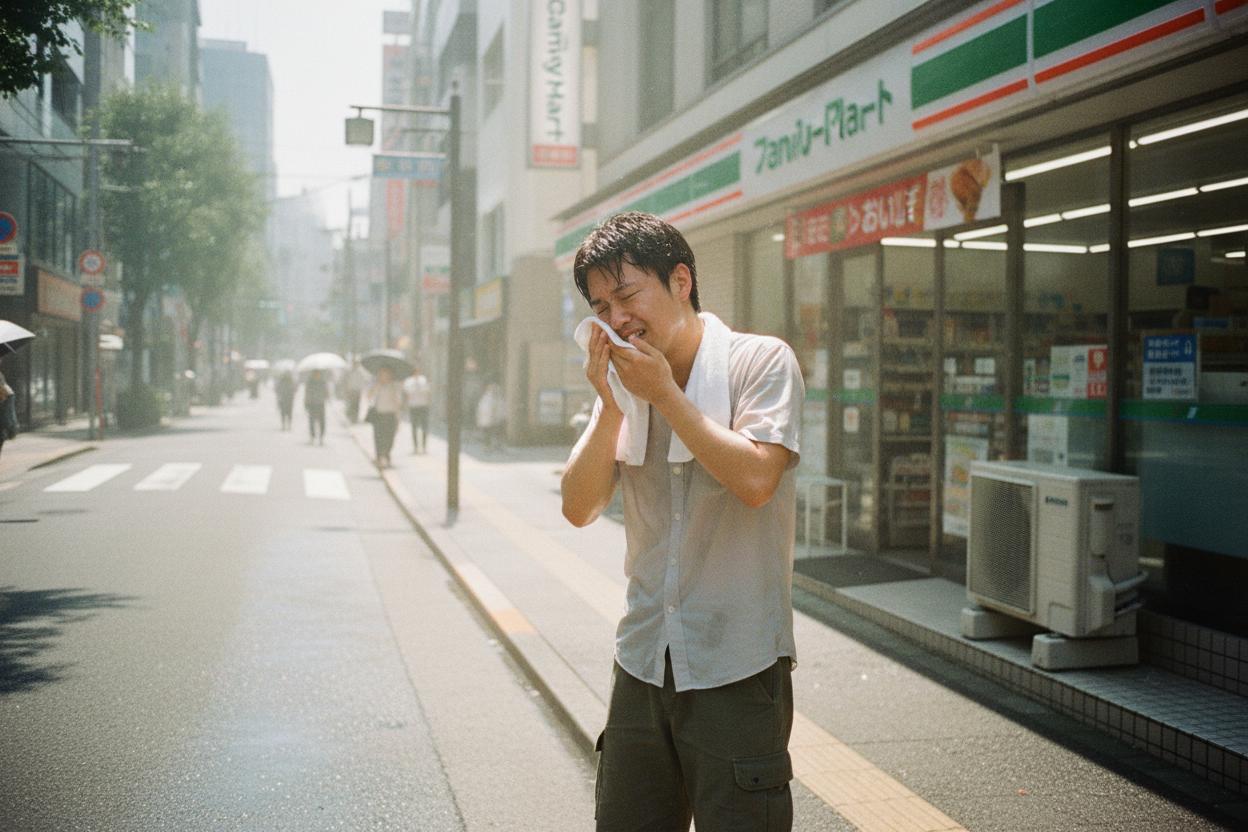
June brings the rainy season (tsuyu). It rains for weeks. Not thunderstorms — just steady, constant drizzle that makes everything damp. Your laundry stops drying on the balcony. You start hanging it indoors, and it takes two days. You notice a musty smell in your closet.
Then July hits. And the humidity becomes a physical force.
It's not just hot. It's 33°C with 78% humidity, which means the heat index is over 42°C. You step outside and your glasses fog up. You walk to the station — a 10-minute walk — and by the time you arrive, your shirt is stuck to your back. You understand, finally, why every Japanese person carries a small towel. It's not a quaint cultural thing. It's survival.
You buy your first dehumidifier. You run it constantly. Your electricity bill jumps by ¥5,000. You don't care — the alternative is mold. You discover that convenience stores sell ice coffee for ¥100, and you buy two per day. You learn which stations have the best air conditioning on their platforms (Tokyo Metro Marunouchi line: excellent. Toei Shinjuku line: terrible).
By mid-August, you're checking the tenki app before leaving home. You know the humidity percentage matters more than the temperature. You've developed a visceral hatred for sunny, humid days — at least cloudy humid days don't bake you.
If you're in Osaka or Nagoya, it's worse. The urban heat island effect is stronger. If you're in Sapporo, you're confused why everyone complains — it's 25°C and you're at a beer garden. If you're in Okinawa, you've given up and just live in the ocean between work hours.
What to buy before your first summer
- Dehumidifier: ¥8,000–¥20,000. Non-negotiable if you're in Tokyo, Osaka, Nagoya, or Fukuoka.
- Small hand towel (tenugui): ¥300–¥800. Carry it everywhere. Wipe your face, neck, hands.
- Uniqlo Airism everything: The only affordable clothing that handles humidity decently.
- Blackout curtains: Essential if your apartment is south-facing. Nitori sells them for ¥3,000–¥8,000.
- Clip-on fan for your desk: Japanese offices often set AC to 28°C "for the environment." You'll need personal airflow.
Months 7–9: Typhoons and Pollen Warning
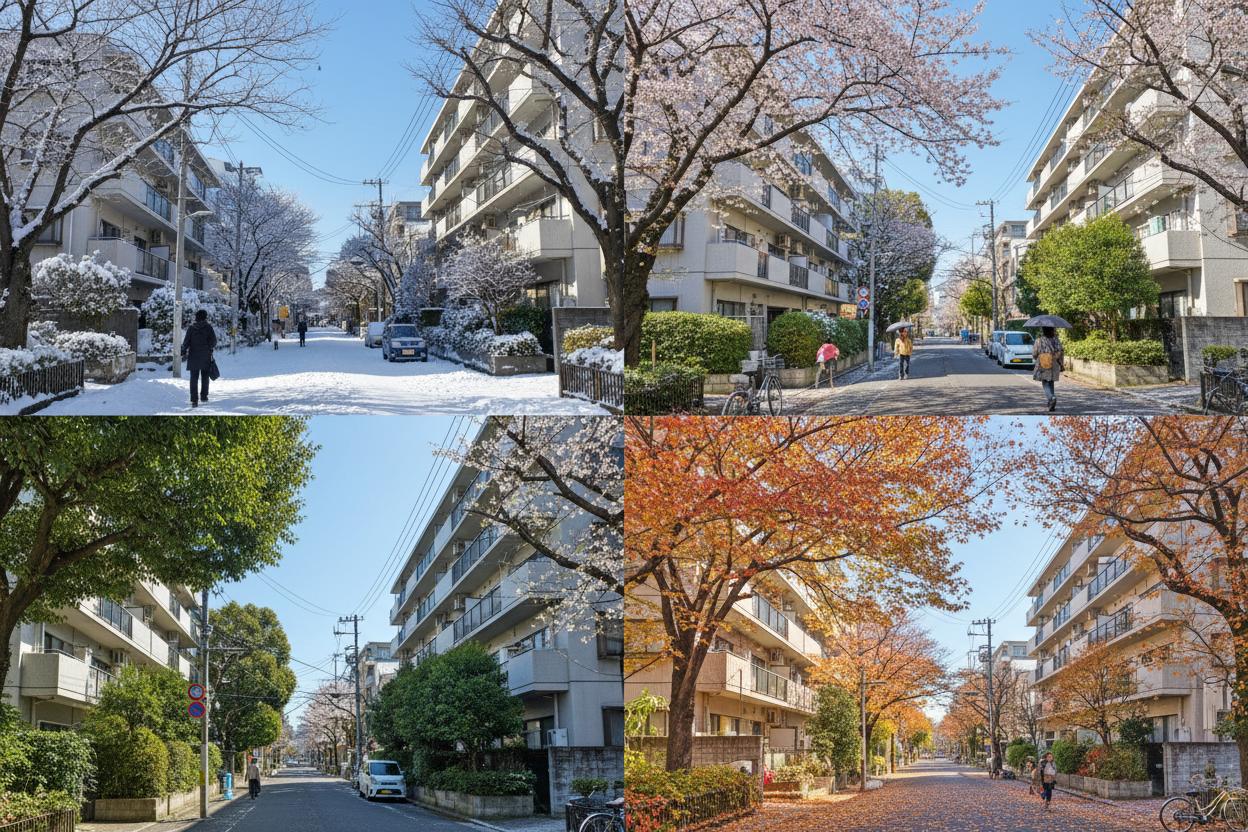
August ends. September brings typhoon season. If you're on the Pacific side or in Okinawa, you'll get alerts on your phone. The tracking is excellent — you know 3–4 days in advance. But when a typhoon hits, everything stops. Trains stop. Stores close. You shelter in your apartment and listen to the wind.
Most typhoons are manageable. A few hours of intense wind and rain, then it's over. But the strong ones — Category 3 and up — can knock out power and water for a day or two. Stock bottled water and shelf-stable food in September. Just in case.
October arrives and the humidity finally drops. You feel like you can breathe again. You open your windows. You start going outside for reasons other than necessity. This is when Japan feels worth it.
But something else starts in October: cedar pollen priming. If you're susceptible to hay fever, your body starts reacting to airborne allergens in autumn, even though the main season is February–April. You might get a runny nose, itchy eyes, or random sneezing fits. You'll think it's a cold. It's probably not.
About 40% of people in Japan experience kafunsho (hay fever) symptoms. The main culprits are sugi (Japanese cedar) and hinoki (cypress) pollen. Tokyo gets hit hard. Sapporo less so. If you've never had seasonal allergies before, don't assume you're immune — many expats develop them in their first or second year.
Buy antihistamines at the pharmacy. Loratadine and cetirizine are available over the counter. They're not as strong as prescription options, but they help. If symptoms are bad, see a doctor — prescription nasal sprays in Japan are effective and affordable.
Months 10–12: Your First Winter
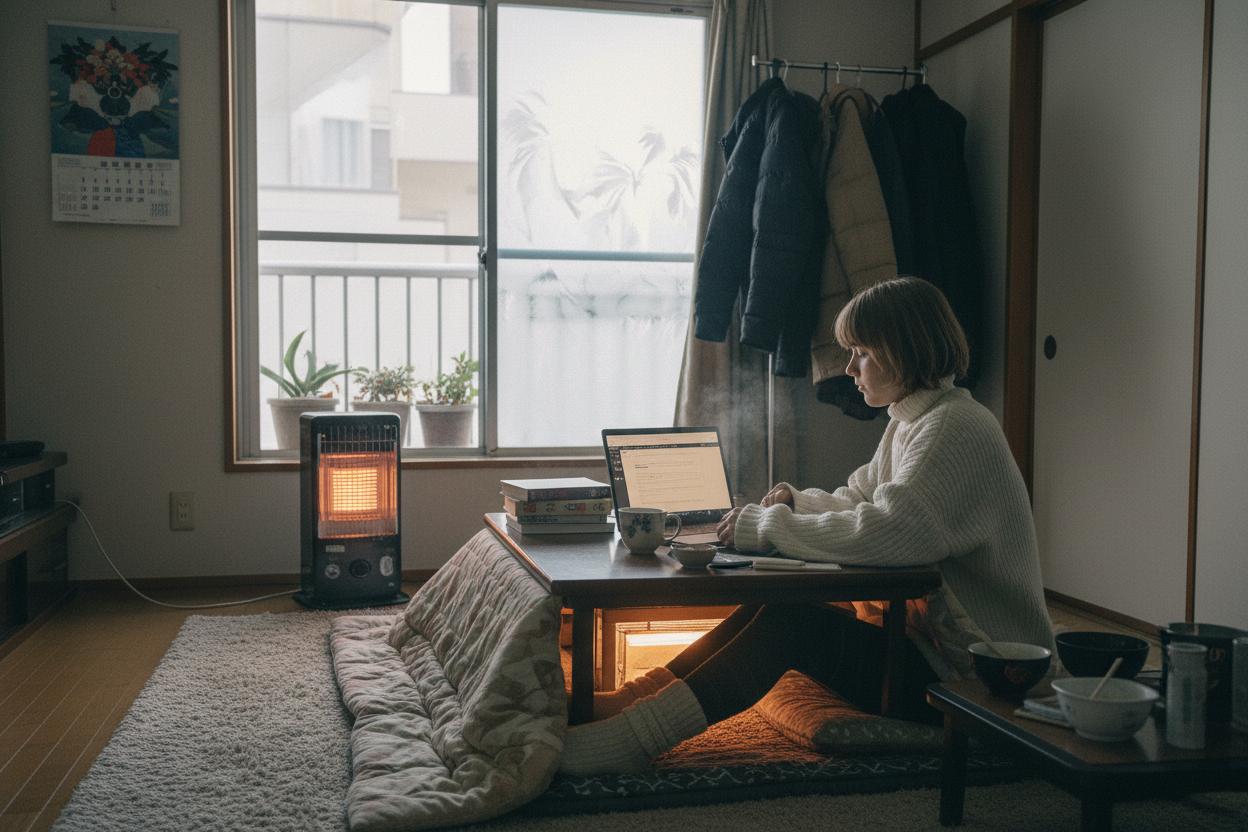
December gets cold. Not cold by northern European or Canadian standards — Tokyo rarely drops below 2°C — but cold in a way that surprises you because Japanese buildings have no central heating.
Remember those thin walls from summer? They're thin in winter too. Your apartment will be 8–12°C in the morning unless you ran the AC heat mode all night. You can see your breath. Getting out of bed becomes a calculated decision. You sprint to the shower, which is the only warm place in the apartment because Japanese bathrooms have built-in heaters.
You discover the kotatsu. It's a low table with a heater underneath and a heavy blanket draped over the edges. You sit on the floor, stick your legs under the blanket, and suddenly winter is bearable. You will spend 80% of your home time at the kotatsu. You'll eat there, work there, watch TV there. It's the greatest Japanese invention since ramen.
Other heating options: space heaters (fast but dry your skin), AC heat mode (slow but even), electric carpets (great for small rooms). We did a full breakdown in our cost of living guide.
If you're in Sapporo or the Sea of Japan side, your winter is different. It's actually cold outside — -10°C, sometimes -15°C. But buildings are insulated! Properly! With double-pane windows and entrance airlocks! You might be warmer in a Sapporo apartment than a Tokyo one because the buildings are designed for winter. The heating bills are higher, but the comfort level is better.
Winter health tips
- Dry skin: The combination of cold air and indoor heating destroys your skin. Buy heavy moisturizer at the drugstore. Nivea cream in the blue tin is ¥400 and works better than expensive options.
- Humidifier: Run one in your bedroom at night. Dry air causes sore throats, nosebleeds, and cracked lips. The humidifier adds ¥500/month to your bill but prevents all of that.
- Vitamin D: Short daylight hours mean less sun exposure. Take a supplement — ¥1,000 for a 2-month supply at the drugstore.
- Layering: Uniqlo Heattech base layers (¥990) under your clothes make a huge difference. Don't rely on thick sweaters — layering traps heat better.
Year 2: You Adapt
By your second year, things change. You know which convenience store has the best ice coffee (7-Eleven, consistently). You know which laundromat dryers actually dry your clothes instead of just tumbling them damp. You check the humidity percentage on your weather app before deciding what to wear.
You've built routines around the climate. In summer, you do grocery shopping at 8 PM when it's slightly cooler. In winter, you keep a sweater by the bed for midnight bathroom trips. You've figured out the exact AC temperature that lets you sleep (24°C with a fan, for most people). You own more than one dehumidifier.
You've also made adjustments you didn't expect. Maybe you moved to a higher floor to escape ground humidity. Maybe you bought a second AC unit. Maybe you started taking the subway instead of walking because the underground stations are air-conditioned and the streets aren't.
The climate doesn't bother you as much because you're prepared. That's the key — preparation, not endurance. Japan's climate is manageable if you know what you're doing. The suffering comes from not knowing.
Health: What Actually Happens
We've covered the seasonal stuff, but let's talk about year-round health concerns related to climate.
Heat stroke: This is real and it hospitalizes people every summer. The signs are dizziness, headache, nausea, and eventually confusion. If you stop sweating despite the heat, that's an emergency. Carry water. Use cooling towels. Don't be the foreigner who collapses at a summer festival because you thought hydration was optional.
Winter dry skin and respiratory issues: The dry winter air causes more problems than the cold. Nosebleeds are common in January. Sore throats wake you up at 3 AM. Get a humidifier before you need it.
Seasonal affective disorder: Tokyo gets about 9.5 hours of daylight in December. Sapporo gets 9. If you're prone to winter depression, the short days plus gray skies can be difficult. Light therapy lamps help — you can buy them on Amazon Japan for ¥3,000–¥8,000. Use it for 20–30 minutes in the morning.
Allergies: Cedar pollen season runs roughly February through April. It affects 40% of the population. Sapporo and Okinawa get less pollen than Tokyo or Osaka. If you're severely allergic, talk to a doctor about prescription options — over-the-counter antihistamines aren't always strong enough.
What We'd Do Differently
We asked our survey respondents: "What would you change about your first apartment choice, knowing what you know about the climate?" The answers were consistent.
Brian (Tokyo → Osaka): "I'd have paid more attention to insulation. My first apartment was a 1985 building in Setagaya. The walls were basically cardboard. I spent ¥18,000 on electricity in August to keep the place at 27°C. My second apartment was 2018-built, ¥20,000 more in rent, and my August bill dropped to ¥10,000."
Mei (Tokyo → Sapporo): "I'd have moved north sooner. I spent two years suffering through Tokyo summers thinking I just needed to adapt. I don't miss the humidity for a single second. The kerosene routine in winter took two weeks to get used to."
Tom (Tokyo, 4th year): "I'd have bought a dehumidifier on day one instead of waiting until I found mold on my shoes. Prevention is cheaper than replacement. Also, south-facing balcony. Non-negotiable."
Your first year will have challenges. The climate will surprise you, probably in unpleasant ways. But by month 12, you'll know what you're doing. You'll have the right gear, the right habits, and the right apartment. And summer number two won't feel anywhere near as brutal as summer number one.
Ready to choose your city? Start with our Climate Zones guide, then check our Apartment Hunting Checklist before you start viewing places.